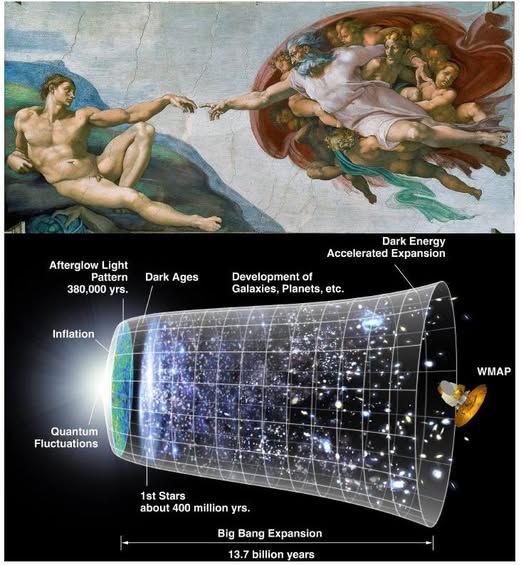
My daughters are deep thinkers. They have asked me how a Christian can believe in Big Bang cosmology and the Bible at the same time? I thought for a long time about how I reason. I was inspired to put my thoughts in writing.
It may be worth remembering that the theory that later received the name ”Big Bang” was introduced in 1931 by a Belgian priest(!) and physicist, Georges Lemaitre. He derived the theory of the beginning of time and space from Einstein’s theory of general relativity. Lemaitre was careful to keep religion and science separate. He believed that there is neither a connection nor a contradiction between faith and the scientific theory of the Big Bang.
My own view is that science is an exercise for the brain. Understanding the Big Bang, the origin of space and time, requires understanding concepts such as the curvature of space-time, the expansion of the void, and a lot of mathematics. It is a fantastic achievement that one has managed to piece together the origin of the universe through a combination of mathematical deduction and astronomical observations.
One is captivated both by the grandeur and beauty of the universe and by the human ability to understand and interpret a reality that lies so far beyond our everyday lives. Anyone who is a believer can appreciate both of these miracles.
My opinion about religion is that it should be considered primarily with the heart.
Jesus commands us in the Sermon on the Mount, ”I say to you, love your enemies and pray for those who persecute you.” This is not a puzzle for the brain to understand but rather a challenge for the heart.
We should not be surprised that the Bible’s creation story does not introduce general relativity and other scientific concepts when it was first written down by nomadic people more than 2,600 years ago. It is beautiful and poetic, and it has given meaning to people for millennia. That the text is not a scientific-logical description of the origin of the universe was understood at least since the 2nd century. The truths contained in it can only be understood if one takes a perspective in this context.
Chapter 1, Verse 1: ”In the beginning God created the heavens and the earth.”
2600 years ago, heaven and earth were essentially all that the universe was understood to be. The central religious truth that we can grasp today is that our world, which is now much larger because we can see further, was created by God.
Chapter 1, Verses 2-5 ”The earth was formless and empty, and darkness was over the surface of the deep, and a wind of God was moving over the surface of the waters. And God said, ”Let there be light!” And there was light. And God saw that the light was good, and he separated the light from the darkness. God called the light day, and the darkness he called night. And there was evening, and there was morning. That was the first day.”
The text continues poetically. How there was evening and morning before the sun was created is a mystery that does not lend itself to logical reasoning, but it sounds beautiful, and appeals to the aesthetic mind!
Chapter 1, Verse 27: ”God created man in his own image, in the image of God he created him; male and female he created them.” * My heart thinks that the reason we can understand Big Bang cosmology and can build and send out spacecraft that can measure and map microwave radiation from the first moments of the universe is that we are created in God’s image. Much like God can create the universe from his thought, so we can make our ideas a reality. That sets us apart from other beings that populate our world.
(Written 2016)
 J. Ebert K. funderar
Lämna en kommentar