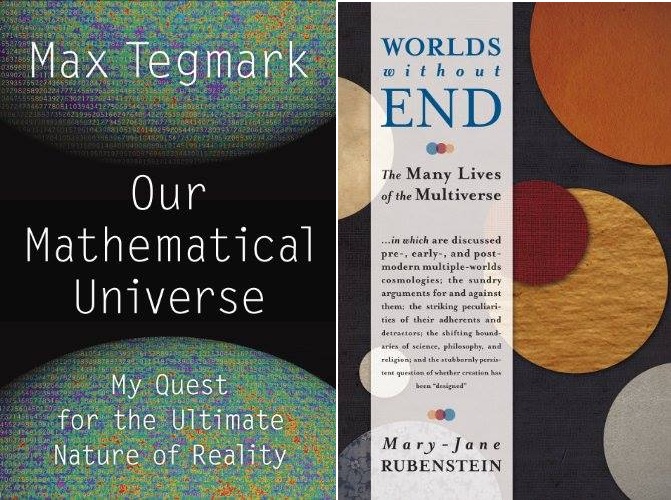
I read ”Our Mathematical Universe” by Max Tegmark. Tegmark is a physicist and cosmologist.
In the book he explores the idea of the multiverse. As scientist gaze into the past toward the big bang, toward the outer reaches of visible universe, or toward the minuscule scale of quantum phenomena, something that can be described as a horizon of what is knowable is encountered. Thus from our point of view, universe is effectively finite.
Tegmark proposes the existence of an infinite number of parallel universes, of which we inhabit one. This sounds outlandish, but Tegmark makes a good case that known physics does not rule this possibility out. But there are now no proofs or experimental evidence for the multiverse, so it is purely speculative.
Now, the strongest case for the multiverse is the same as is frequently used to justify the existence of a creator God. The fact is that our own existence is an extremely improbable coincidence if it has come about by chance only. This is a point that Tegmark strongly elucidates. Either this could make us believe that our universe was somehow deliberately designed. Or, we could believe that there is an infinite number of universes so that even the most improbable universes will exist somewhere an infinite number of times. Tegmark espouses this second line of thought.
I found that the book tickled my mind and found the links toward religion intriguing but Tegmark does not explore this any further.
So I searched and found the book ”Worlds without End” by Mary-Jane Rubinstein. Rubinstein is a theologian. She is a very serious professional in her field, just like Tegmark is in physics. She surveys the field of thought around the multiverse and shows that this idea is much older than modern physics. For instance, Hinduism and old Mayan religion supposes that the world is destroyed and reborn in an endless cycle, thus creating a time sequential multiverse.
She explores the implications of the multiverse idea and points to the possibilities of ”simulated” universes being created by intelligent creators inside other universes.
She shows that the multiverse hypothesis leads to a giant tangle of possibilities where it seems nothing is impossible or can be ruled out.
I enjoyed reading both books. But Rubinstein’s book is the more enlightening.
(Written 2017)
 J. Ebert K. funderar
Lämna en kommentar